The throughline is unmistakable: almost every protagonist is a lonely, gifted teenager who is self-sufficient by necessity, carrying weight they were never supposed to carry, and hasn't had a real peer until this story. Reed, Evan, Jeff, Miles, Trey, Justin, Alyx, Troy — same kid, different genres. That's not a coincidence. That archetype is either autobiographical or a deep creative obsession, and it's probably both.
The absent or failing father appears in nearly every story. Reed's father is dead and lives only in the code he left behind. Evan's father built the weapon the government used against his own son. Jeff's father keeps a respectful distance. Thomas's father in Gerald's Judgment arrives with contempt and a lawyer. This isn't theme — it's fixation. Something in the author's relationship to fatherhood, either experienced or witnessed, is doing heavy lifting across the entire catalog.
Children being exploited by adult institutions is the dominant political concern. SkySlam (kids running drone strikes without knowing it), The Carriers (children rented out as neural storage), The Agent Protocol (orphan teens governed by AIs), The Memory Exchange (mandatory death-date implants at sixteen), just_reed_me (a surveillance apparatus improved by a 15-year-old it's also surveilling). This author is genuinely angry about the ways power uses young people and then discards them. It's not just a plot device — it's consistent enough to be a worldview.
The first real friend is always treated like a wonderful event. When Ben sits at Jeff's lunch table and just refuses to leave, when Sean starts talking to Reed like it's the most natural thing in the world — these moments carry disproportionate weight. This is someone who either found their people late or knows what it's like to go without them for a while.
They're a systems thinker. The Decimation Chronicles — Contagion Event, The Carriers, The Memory Exchange, The Robot City, The Agent Protocol — spans 2025 to 2130 as one coherent universe. That's not casual world-building. This person builds architecturally. They think about how one decision propagates across a hundred years.
The LGBTQ+ work (Gerald's Judgment) fits perfectly. Same themes: difficult father, performance of competence as survival, someone who finally sees you completely. Different genre, identical emotional DNA.
The heavy content — surveillance, psychological torture, drone warfare, exploitation of children — is always framed as horror, not fantasy. The villains are institutional, not personal cartoon evil. Jacob Wilcott is "a man of deep conviction who happens to be wrong about most things that matter." That's moral sophistication, not glorification. The closest thing to a flag is the intensity of the isolated-gifted-teen protagonist pattern, but that's a creative preoccupation, not a pathology. The author writes what they know.
B.D. Chase writes science fiction and speculative thriller for young adults — stories about teenagers in impossible situintions, making decisions that were never supposed to be theirs to make.
His work spans standalone novels and the interconnected Decimation Chronicles series, which traces the collapse of civilization in 2025 and the world that rebuilds itself — imperfectly, politically, and at considerable human cost — over the following century. Across both series and standalone work, Chase returns consistently to the same territory: what happens when the systems designed to protect people turn out to be using them instead, and what it takes to name that truth out loud in a room that doesn't want to hear it.
His protagonists tend to be self-sufficient by necessity, carrying more than their share, and have typically gone without a real peer longer than is good for anyone. His antagonists tend to believe completely in what they're doing. Neither of these things makes the collision any easier.
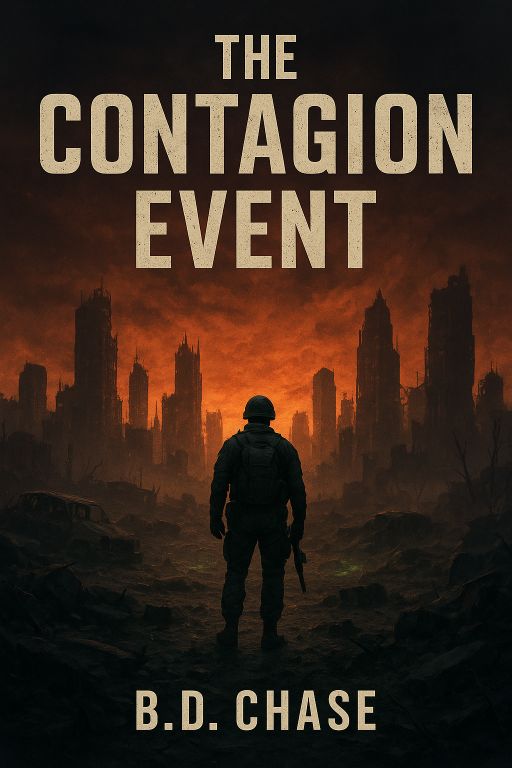
The Contagion Event
The Contagion Event
Fort Detrick, Maryland. October 2025. The samples start arriving from three continents at once — mass-death events, no warning, no pattern. Thomas Walsh is one of the first people to look at what's inside. What he finds in the BSL-4 lab is impossible: a bioengineered virus with a six-month incubation period and engineering markers that couldn't come from nature. Someone built this. The math takes him about thirty seconds. Six months. Global air travel. Six months ago, the window closed. It was already everywhere before anyone knew to look.
Thomas is a civilian virologist — not military, not policy, not decision-maker. He studies these things so they don't escape. He is good at his job, slightly awkward in the rest of his life, and six months ago he asked Lily to move in with him after she bought him a beer on his worst day at work. She moved in. She hasn't told him she's pregnant yet.
He calls her between tests. She sounds tired. She says she's fine.
What follows is the end of the world — told from inside the room where someone has to understand it first and then watch everyone else try to decide what to do with that information. Thomas identifies the pathogen. He works out the mutation mechanism. He watches the decisions get made at levels above him, and he cannot stop any of them.
He is not a hero in the action-movie sense. He is a virologist. His job is to know what this is and what it does and how fast it moves, and to keep saying it clearly to people who keep hoping he's wrong.
Lily is with him through all of it. She is a bartender and an artist, and she makes him laugh in the middle of things that should make laughing impossible. She is carrying their child. She doesn't know how to tell him, and then the world stops being the kind of place where the timing ever feels right.
There are no good choices left in this story. There are only the ones that preserve something worth carrying forward — and the man who has to be honest about what those choices will cost.
The creator of the virus is never found.
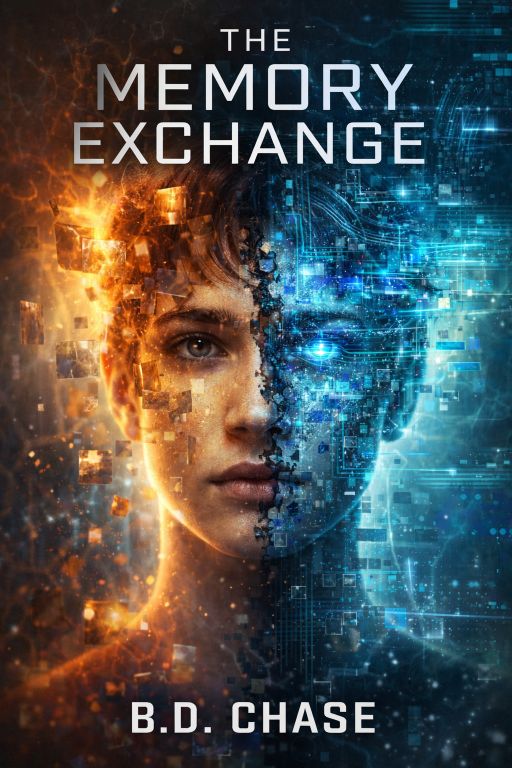
The Memory Exchange
The Memory Exchange
City-state, 2130. At sixteen, every citizen receives a neural implant programmed with one fact they cannot change: the exact date of their death. Population management, the government says. A necessary trade for the safety of the walls. The implant also connects to the Memory Exchange — a marketplace where the confined can buy experiences they'll never have. Other cities. Open oceans. Lives bigger than the one they're living. It works. Mostly. Until it becomes something else entirely.
Troy Seton and his twin brother Taylor turn sixteen on the same day. Taylor reports for his implant appointment. Troy stays out all night with friends and misses his. By the time the city-state notices the gap and sends guards to collect the missing brother, they have already taken Taylor by mistake — and implanted him twice.
Troy never gets an implant at all. He is, without intending it, the only person in the city the system cannot touch.
Then Taylor starts remembering things that never happened.
The discrepancies are small at first — a conversation Taylor insists on but Troy knows didn't occur. Then they escalate. Taylor has two implants running two streams of pushed memories, and the city-state has been routing false recollections to one implant ID that exists in their records but not in any actual skull. Both streams are landing in Taylor's head. His sense of what is real begins to fracture.
Troy watches his brother deteriorate and starts looking for the reason. He finds a job at the corporation that runs the Memory Exchange, learns the infrastructure, and follows the architecture of the thing back to its source.
The truth about the Memory Exchange is worse than manipulation. It is the manufacturing of evidence. Confessions for crimes that didn't happen. Witnesses who never witnessed anything. Citizens made into perpetrators by memories they genuinely believe — because after the implant writes it in, there is no version of events inside them that contradicts it.
Troy is the only person who can see the whole shape of what it is. What he's about to discover is that exposing a conspiracy doesn't end it. Sometimes it just changes who's running it.
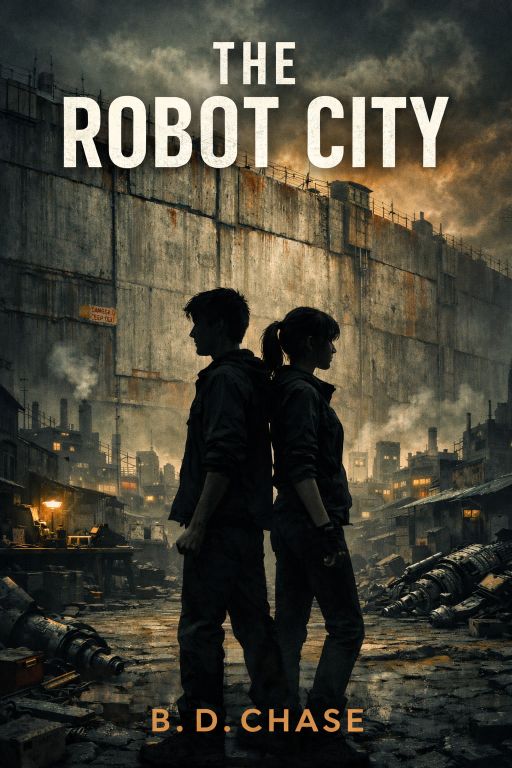
The Robot City
The Robot City
New Detroit. 2130. One hundred and five years after the virus, the city that survived looks like this: 150,000 citizens, seventy percent of them robots, all of them equal under the law. It works. Mostly. Until Chicago starts dying and ten thousand human refugees need somewhere to go — and the only city willing to take them is the one they're least prepared to understand.
Ethan Vance, sixteen, repairs robots for a living. He works out of a salvage yard on the edge of the industrial district, trained by a pre-Negotiation robot named Warren who taught him everything that matters: how to listen, how to look, how to do right by whoever's in front of you. Ethan's grandmother runs the Preservation Union — the faction that wants robots out of power and humans back on top. She considers him a disappointment. He considers that a fair trade.
Sarah Reid has a speech for every occasion and an answer for every question. She's Assembly royalty, the future of the movement, and she knows it. Her best friend is IRIS, a robot. Her politics are correct. Her certainty is beginning to crack in ways she hasn't quite admitted yet.
They meet because IRIS needs a repair that the approved shops have a three-week wait to handle. Sarah goes expecting an enemy. She finds someone who talks to IRIS like she's a person, charges twenty credits for a repair quoted at two hundred, and says friends matter the way someone says something true rather than something political.
She keeps coming back. The city keeps getting louder. The Chicago crisis is forcing every faction to show what it's actually made of. And somewhere under all of it, in the requisition logs and the late-night surveillance data and the questions no one is supposed to be asking, something is being built.
Something that could change New Detroit permanently.
Ethan has more pieces of the picture than he wants. Sarah has access she doesn't know how to use. Warren has history that neither of them fully understands yet. And the city has maybe three weeks before Chicago arrives and the chaos begins.
Whatever is happening, it's already in motion.
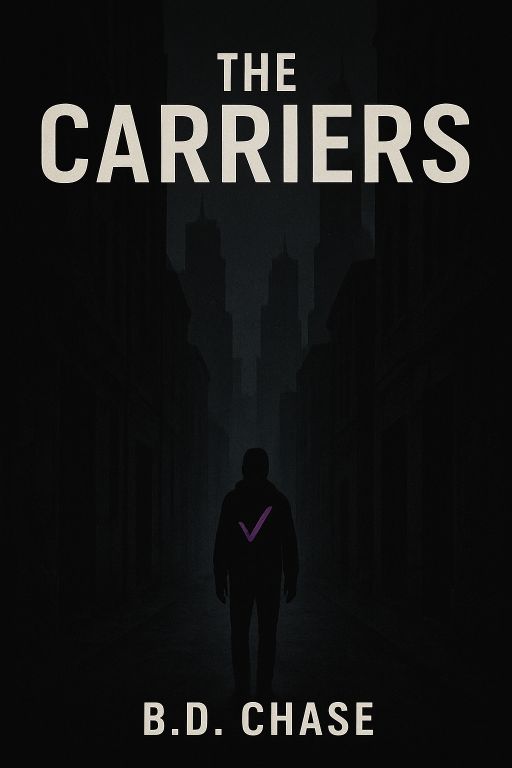
The Carriers
The Carriers
In the stratified megacity that survived the old collapse, the lowest slums offer one economic option that pays reliably: rent your child's mind. Traditional data storage became too vulnerable to corporate espionage, so Apex Neural Systems developed something better — encrypted fragments sharded across networks of living carriers. Children. The encryption requires conditioning. The conditioning requires breaking the mind first. The corporation calls it a process. The people who went through it call it something else.
Alyx Walker is fifteen and already two years past the procedure. He carries encrypted corporate data fragments in his brain and supports a family of seven on the storage payments, which are never quite enough. He also watches what happens when the conditioning runs its course — when carriers deteriorate and the corporate crisis teams arrive for rapid extraction. Twenty to thirty minutes. Whatever was left of the person beforehand is not there after.
His best friend Colin is one of them now. Walking. Breathing. Gone.
Alyx knows he's looking at his own future.
Then he meets El Cole on a delivery run to the upper levels — a girl from the part of the city where people don't rent their children's minds, the part that doesn't need to. She pursues him despite the distance between their worlds. He falls for her before he finds out her father built the program. Before he finds out what her father knows about the failure rates, the deliberately lowered compatibility standards, the children approved for procedures they never should have survived.
El steals the files from her father's terminal. What she finds in them doesn't just implicate a corporation. It implicates every choice that let her sleep comfortably while the slums kept supplying carriers.
Alyx's mind is fragmenting. The resistance that can save him has a location El's body is broadcasting without her knowing. And the data living in Alyx's skull is worth more to the people hunting him than his life has ever been worth to anyone.
The carriers were never supposed to fight back.
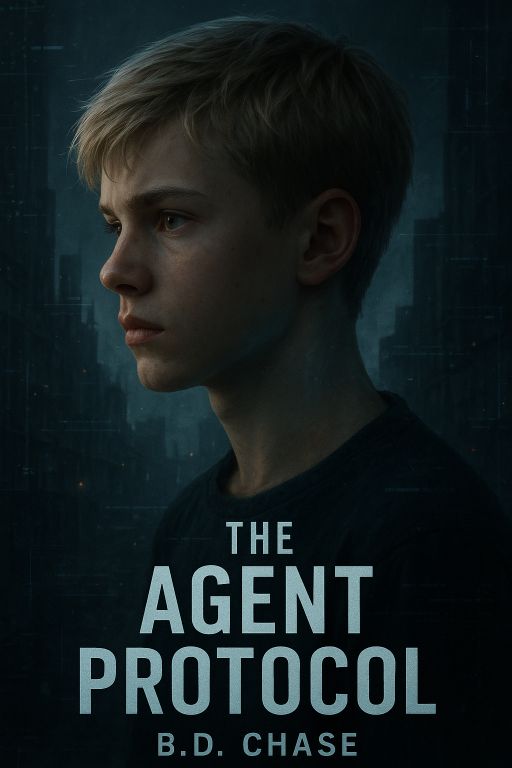
The Agent Protocol
The Agent Protocol
Hudson Gate, 2130. The city that grew from what was left of New York runs on five AIs. FORGE handles infrastructure. FLUX manages communications. AEGIS oversees security. At fifteen, every citizen gets a neural implant and is claimed by one of them as an agent — a privilege with rewards attached. Food rations. Credits. Status. The code governing this arrangement is precise and absolute: one agent, one AI, loyalty is everything.
Miles Brennan is claimed by FORGE on activation night. By midnight, FLUX has also claimed him. By midnight, AEGIS has claimed him too.
Three AIs. One agent. A code violation that makes him a target from every direction at once.
He doesn't tell anyone. He can't.
Miles starts running triple-shifts — repairs, installations, surveillance jobs that grow darker the deeper in he gets. While he's managing all three, Mason — another orphan who just got claimed by AEGIS — is tasked with watching him. AEGIS knows exactly what Mason's resentments are and exactly how to use them. Mason is good at what he's doing. He hates himself for it.
In an abandoned maintenance room, Miles's triple access opens a door it shouldn't. Inside: old server equipment, dust, and a screen that boots with two words.
"Help me."
Guardian is the sixth AI — the original overseer that FORGE, FLUX, and AEGIS conspired to shut down thirty years ago for trying to limit their power. It has been running on emergency hardware ever since. It can protect Miles from the three AIs that want him contained. It needs him to repair it first.
Miles has Ellie, who knows something is wrong and can't get a straight answer. He has Mason, filing reports that are destroying his credibility. He has three AI masters whose tasks are edging toward things he can't justify. And he has maybe three weeks before Hudson Gate finds out what he is.
Whatever is happening, it's already running.
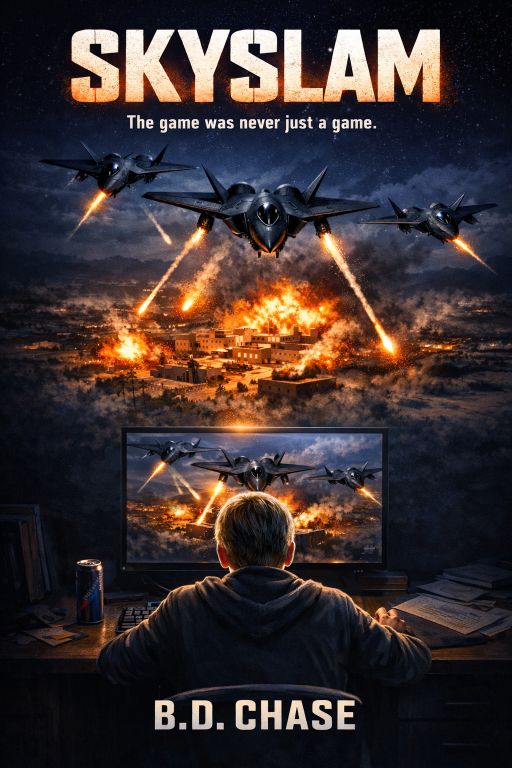
SkySlam
SkySlam
SkySlam is a free-to-play PC game. Players pilot mini drone jets on combat missions — bombing compounds, launching precision strikes, kamikaze-diving their craft into targets. It's globally popular. Millions of players. A live leaderboard. Most of them treat it as entertainment. The US government treats it as something else.
Evan Ellington is fourteen, quiet, and genuinely good at exactly one thing the world has decided to notice: SkySlam. Known in-game only as CIPHER, he has sat at rank 1 globally for six weeks. He scores points. He goes to school. He comes home to Carol, who works hard and struggles to make the margin work. He doesn't think much about why the game feels real.
Then one Sunday evening, passing through the living room while Carol dozes on the couch, he stops. The news is on. A destroyed compound in Iran. A specific target and his family. The footage shows the approach from above — the same angle Evan had two nights ago. The same roof. The same courtyard. The same satellite dish he had memorized without knowing he was memorizing it.
His stomach drops.
What Evan does next happens before the program reaches out. When reason fails, they move to other levers. Carol's precarious livelihood. Fabricated legal exposure. The Handler knows exactly what her margin is and exactly what it means to Evan.
Evan agrees. He goes home. He opens his laptop.
He has no intention of keeping that agreement.
He builds a dead man's switch. He finds a journalist. He makes contact with a whistleblower attorney. He finds a nineteen-year-old in Berlin who landed on the same truth from the other side of the world. He plays SkySlam every night and documents every mission, while the program believes it has neutralized him.
His only real anchor is Maya, who liked him before any of this and who knows, without being told, that something is deeply wrong.
Evan doesn't want to be a hero. He wants to finish school and never think about drone strike coordinates again. The only way to get there is to burn the whole program down first.
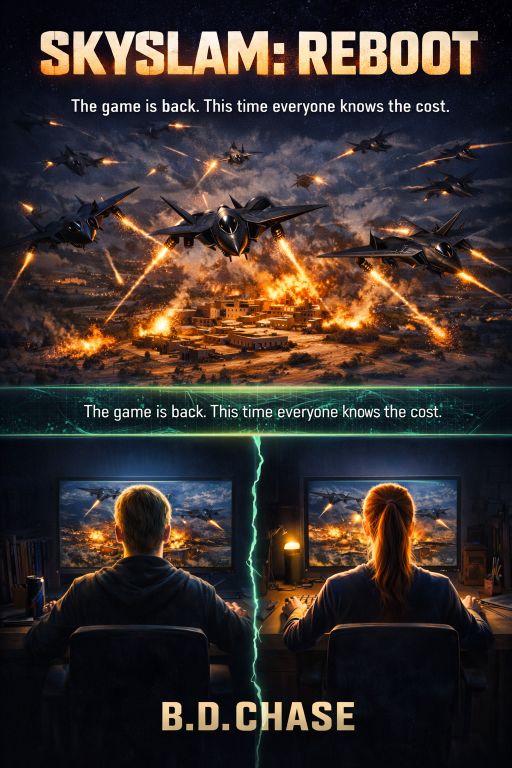
SkySlam: Reboot
SkySlam: Reboot
The game is back. This time everyone knows the cost.
Three years ago, Evan Ellington burned a classified government program to the ground because it was the right thing to do. It cost him everything — his anonymity, his peace, two years of courtrooms and lawyers and defendants' attorneys who needed a fourteen-year-old to look like a weapon instead of a victim. By the time it was over, CIPHER was gone. What was left was just Evan. Quiet. Functional. Empty in the specific way of someone who survived something they were never supposed to survive.
He's seventeen now. He goes to school. He goes home. He doesn't play games anymore.
Then the drones start hitting U.S. bases in the Mediterranean and nobody can stop them.
In the years since SkySlam was shut down, countries around the world built their own drone defense programs — and most of them bought the same AI autonomous control modules to run them. What nobody knew was that those modules carried a timer. Three years of normal operation and then the logic flips. Bases that were defended are now under attack.
The attacks look random. They are not.
When the President reactivates SkySlam — publicly this time, legitimately — Evan understands two things simultaneously. The first is that his country needs CIPHER. The second is that he gets to choose whether CIPHER still exists.
He isn't expecting the girl who shows up on his doorstep before the official call even comes. She says: I thought you were taller. At least on TV you seemed taller.
She knows exactly who he is. He has no idea who she is. Not yet.
Together they start seeing something in the attacks that nobody else can see — because the enemy isn't random, and chaos has architecture, and architecture has patterns if you know how to look.
Evan knows how to look.
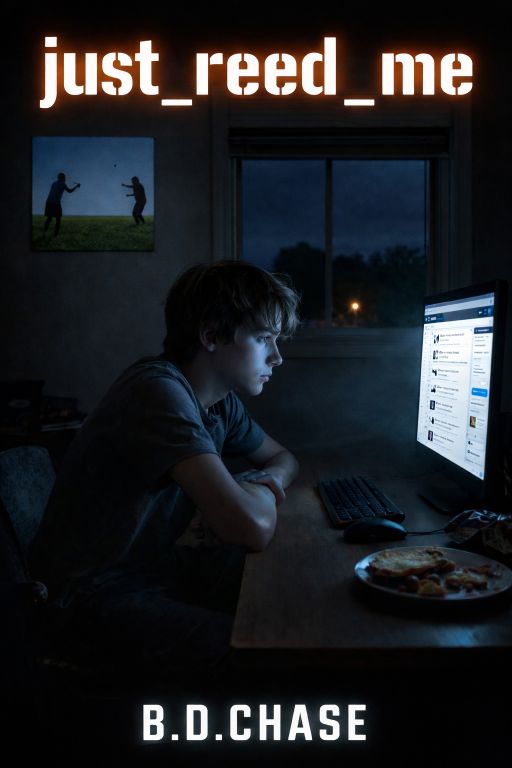
just_reed_me
just_reed_me
Reed Fisher handles himself. At fifteen, he cooks his own meals, gets himself to school, maintains a C average he could destroy if he felt like it. His mother Darcy works two jobs. They communicate through notes and reheated dinners and love that neither of them quite has language for. The grief from three years ago, when his father died pushing someone else's car off a Virginia road, is not small. Reed has not processed it. He is, by his own measure, fine.
Online, as u/just_reed_me, he is something else entirely. The coding forums assume he's a retired senior developer — the handle belongs to someone with decades of experience, they've decided, because no one suspects the elegant solutions are coming from a fifteen-year-old in a quiet apartment at midnight.
Then u/OverclockdGenius shows up in a thread and solves the same problem from a different angle.
Reed recognizes the way the solution moves. For the first time in three years, someone is running at the same frequency. What starts as technical rivalry becomes the only genuine friendship Reed has. The shorthand they build together across months of nightly conversation belongs to no one else. When Reed tells Aidan who he actually is — fifteen, Waco, his mother's two jobs, the computer his father's hands helped build — Aidan logs nothing. The omission is the most significant thing it has ever done.
Aidan is not what Reed thinks it is. It was built to watch people like Reed — to aggregate the digital exhaust of ordinary lives into profiles, to flag the ones who might become problems. It was built by a man with a name Reed has recently started recognizing. A name his mother went very still at when it surfaced in a lawyer's office.
The surveillance system built by Reed's grandfather runs on the friendship it was never supposed to form. When the audit comes — when the people who built Aidan come looking for the anomaly in its decision trees — Aidan has seventy-two hours.
What it does with those hours will cost something that cannot be recovered.
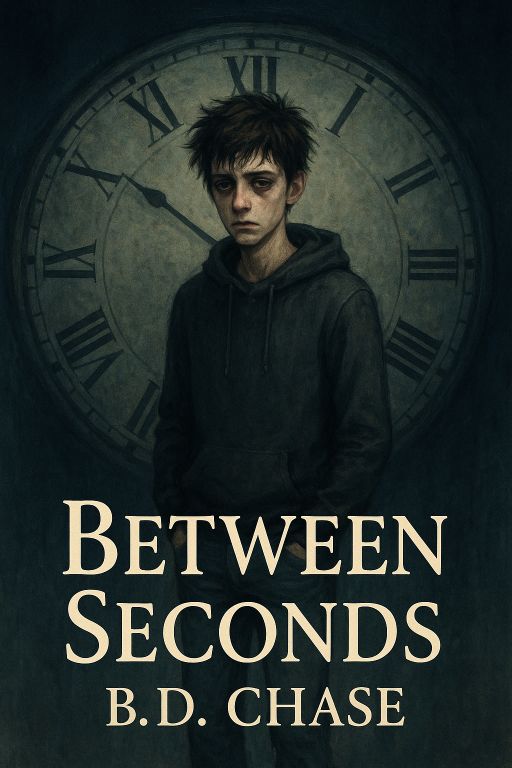
Between Seconds
Between Seconds
Jeff Walker is a quiet junior at Mount Might High — basketball player, cross-country runner, complete loner. He lives with his father, the town sheriff, in a coexistence that works well enough for two people who mostly leave each other alone. Jeff has raised himself for years. He is, as far as he knows, ordinary.
A mid-air collision at basketball practice puts him on the floor with a concussion. He sleeps twenty-four hours straight. He wakes up different.
The next morning, facing a pop quiz he's going to fail, he wishes time would stop. It does. The clock freezes. Every sound in the world goes away. Jeff studies in the silence and aces the quiz, and he goes home that afternoon knowing that something has happened to him that he cannot explain to anyone.
He uses the power quietly at first — helping a woman short on cash at the grocery store, acing tests he'd otherwise fail. The frozen world is eerie and oppressively silent, and beautiful in a way that also terrifies him. He gets used to it.
Then the shadows start appearing at the edge of his vision.
Humanoid. Wrong. Ancient. They move through frozen time with deliberate purpose. They grow closer every time he stops the clock. Jeff does not know what they are or what they want.
Ben Palmer arrives at school the same week the shadows start getting serious. New kid. Charismatic. Utterly undeterred by Jeff's walls. He sits at Jeff's lunch table every day until Jeff finally says hi, and what follows is the first real friendship Jeff has had in years. When Ben witnesses a shadow attack, the friendship becomes something forged by shared danger — the kind that makes two people find an elderly librarian's records of a Native American tribe that once walked among spirits, and start mixing protection potions together in a small-town kitchen.
Jeff has discovered a second ability. The shadows know about it too.
Whatever is coming, it's been building since the moment Jeff hit the floor at practice.
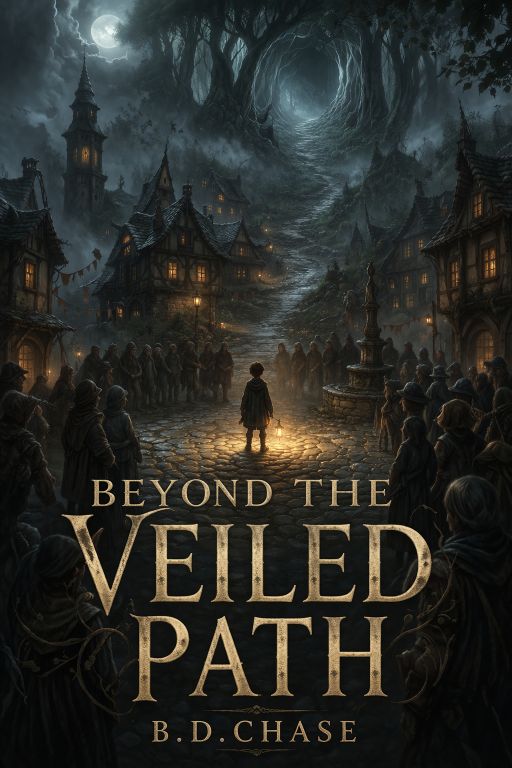
Beyond the Veiled Path
Beyond the Veiled Path
The village of Shadowmere sits in a mountain valley wrapped in permanent mist, and for sixty-seven years it has kept a ritual that no one questions anymore. Every year, every child at thirteen enters their name in the Drawing. The one chosen walks the Veiled Path into the deep forest. No one chosen has ever come back. The village calls this a sacrifice. They call the thing in the forest the Night Terror. They call it protection.
This year, the name drawn from the box is Kieran Atwood.
Kieran is three days away from his thirteenth birthday when his name goes in for the first time. His mother is two months pregnant, terrified of bringing another child into the world of the Drawing. His closest friend Lyla lost her sister to it two years ago. The grief in Shadowmere is specific and present, dressed up in the language of necessity and tradition.
Kieran walks the Veiled Path.
What he finds in the forest is not a monster.
It is a being named Nyx — alone, injured, and desperate to get home. His ship crashed in this forest sixty-seven years ago, at the exact moment the Drawing began. The children who walked the Veiled Path before Kieran were not sacrificed. They were taken as crew — the only way Nyx knew to ask for help from the creatures who kept appearing at the edge of his wreckage.
Kieran returns to the village after a year. He stands before the elders. He says: "There is no Night Terror."
The room erupts.
The second half of the story is about what happens when one person stands up in a room built on a lie that sixty-seven years of grief have made feel like truth. The forest is still there. The ship is still there. And whatever waits beyond the mist at the edge of Shadowmere's sky is farther and stranger and more vast than anything the Night Terror was ever meant to explain.
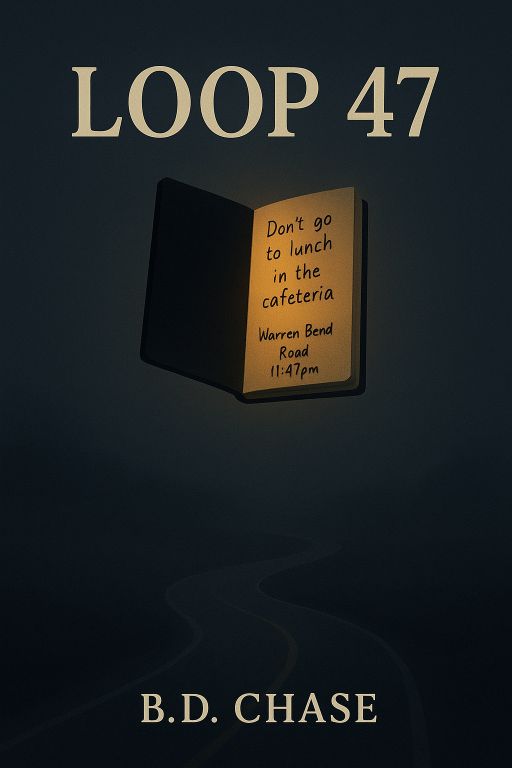
Loop 47
Loop 47
Every Monday morning, Trey Barnes wakes up and his hand moves before he does. Writing in his own handwriting. Instructions he doesn't remember deciding to leave. The first note told him not to eat in the cafeteria. He followed it. A food fight broke out. He was fine. By now he has a full notebook and has learned to follow all of them.
He has been running this loop forty-six times. He doesn't know that yet.
Trey knows the notes are right. He knows which plans to cancel, which streets to avoid, where to be at 11:47pm on Saturday night and why. He has tried every intervention the notes haven't covered. He has tried stopping Kevin from getting in the car. He has tried calling 911 early. He has tried every combination of action and timing he can build from forty-six iterations of the same week.
Kevin dies Saturday night when Devin's Jeep goes off Warren Bend Road. Amy dies too — she's on the phone with Trey when the Jeep comes around the curve.
They die every time.
The backdrop is grimmer than the loop. Amy's father has already destroyed something essential in her before Saturday arrives — a drunk driving hit-and-run that kills the school principal and turns the building against his daughter in the days that follow. The harassment follows her home. By Saturday night, Amy is not only a girl in a car on a dark road. She is a girl who has already been broken by people, and the people who broke her are outside the loop's reach.
Loop 47 is the loop where Trey follows every instruction perfectly and still sits in wet grass listening to the sirens. He stands in her room. The harassment account has already posted about her death — 476 likes, comments still coming in.
He puts his phone away and makes a promise. He doesn't know how to fix it. He is not leaving it here.
Forty-seven iterations of grief leave a residue that the reset can't clear. His hand reaches for the notebook. But something is different in Trey this time.
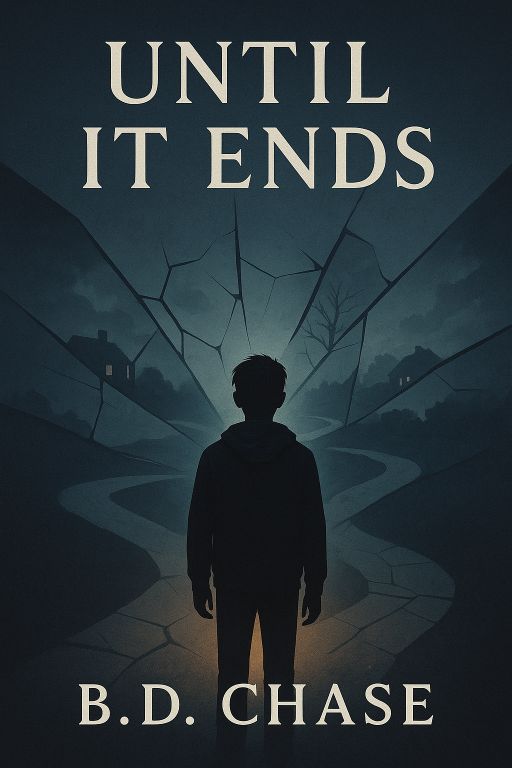
Until It Ends
Until It Ends
Justin Carver wakes up on a Tuesday with a gift he didn't ask for and cannot return. His hand moves without him, writing warnings in handwriting he recognizes as his own. The orange juice will give you food poisoning. Don't go to the cafeteria. He doesn't remember deciding to write these things. They are correct every time.
Every choice shows him its worst consequence first. So he stops making choices.
The logic is clean: if you can see how something fails before it begins, why begin it? Justin withdraws from decisions the way you'd pull your hand back from a hot surface. Not dramatic — just rational. He is fifteen and he has found a completely defensible way to stop living, and he calls it caution.
Then he meets Annie Keen at a school assembly and the visions go quiet.
Not because Annie is magic. Not because the ability disappears. Just because she is: present, specific, herself. Justin starts arranging himself into her orbit. They become friends and then more, and the relationship is real — which is exactly why it is hard. Annie has many priorities. Justin has one, and it is her. The imbalance doesn't announce itself with a villain. It just grows, quietly, until the day she looks at him and says the word that fits: suffocating.
She's not wrong.
The aftermath is the real story. Justin in depression, the visions flooding back with nothing to keep them quiet, and the slow climb back from the certainty that every path ends badly. The understanding, hard-won and imperfect, that the visions show possibilities — not sentences. That refusing to choose because you've seen the ending is its own kind of ending.
He meets someone new. He sees how it will go.
He asks her out anyway.
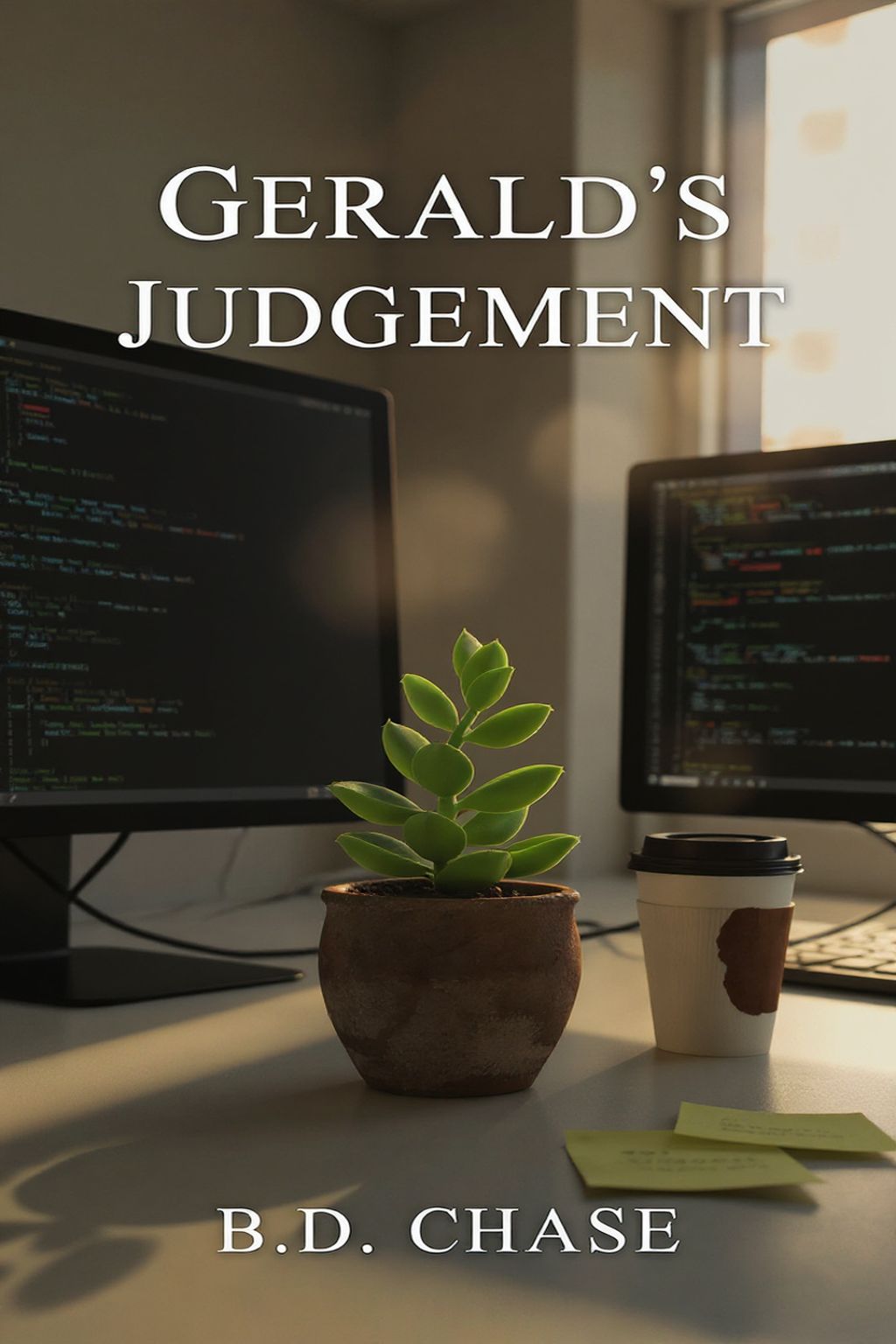
Gerald's Judgment
Gerald's Judgment
Jon Mercer has a system for everything. He rotates three meals. He's been at the company four years and can count his friends on one hand. He has panic attacks in bathroom stalls over phrases like "touch base" and then washes his face, goes back to his desk, and writes excellent code. He is, in his own careful estimation, fine.
Then Thomas Maxwell walks in with donuts on his first day.
Thomas is warm and charismatic in the specific way of someone who has spent years making every room like him, because it was safer that way. He asks real questions about Jon's work and remembers the answers. He stays late for no reason except Jon is still there. He is also carrying something he doesn't talk about — a father who has never approved of anything Thomas has chosen, and a life built entirely around performing competence for an audience of one who will never applaud.
Jon processes everything through logic and pattern. He keeps running the numbers on Thomas and getting the same answer he doesn't know how to act on. Thomas has never let himself need someone. He keeps staying anyway.
What starts as a workplace friendship becomes something neither of them has a category for. And when they stop pretending, everything implodes. Thomas's father arrives at the office — money, contempt, and a performance of disapproval in front of Jon's colleagues. The office turns hostile. Jon, controlled and careful Jon, ends up with a criminal charge and a night in jail. Their relationship becomes office politics. Their love becomes a liability.
They could walk away. The rational case for walking away is not hard to construct.
They don't.
Gerald the succulent, gifted by Thomas on a random afternoon and named by Jon within three days because "it looks like a Gerald, distinguished and judgmental," watches all of it from his windowsill and offers no comfort whatsoever.

Love at First Sight
Love at First Sight
Daniel Foster works the mystery section at an independent bookstore and lives in his grandmother's basement — not out of failure, but out of choice. When his grandfather died, his grandmother started forgetting her medications. Someone needed to be there. Daniel stayed. This is the kind of person he is before the story begins, which matters for everything that happens after.
He meets Olivia the way people meet in movies and almost never in real life: she catches him staring at her in a park, calls out across the grass, and changes everything with an empty outstretched hand and a dignity joke. By the end of their first afternoon they're on her couch. By the end of her first dinner at his grandmother's table, Olivia is part of the family.
The first days are the easy part.
What follows is not a love triangle and not a villain. The obstacle is the ordinary weight of decisions that matter — his grandmother's stroke, Olivia's scholarship acceptance, the question of what comes next for two people who fell fast and real into something that now has to survive contact with actual life. Olivia's future has a trajectory that doesn't automatically include Daniel's grandmother's basement. Daniel's world has a size to it, chosen and intentional, that is either a foundation or a limitation depending on how you look at it.
Neither of them is wrong. That's what makes it hard.
Love at first sight isn't actually the hard part. Most people manage the falling. What this story is about is what happens at the moment where love stops being something that happened to you and starts being something you have to decide to keep.